Prologue
What this site is — and why
"AKTE KÖNIGSBLAU" is for lovers and haters of the Knappen alike. History becomes legend, legend becomes myth. And myth becomes cult — or a reason for eternal second-hand embarrassment, depending on the event.
Look but don't touch. Four minutes and 38 seconds as German champions — then Bayern came. Schalke 04 are the club of great tragedies: the 2001 championship drama, the crash into the second division in 2021, Tönnies, Assauer, Asamoah. With over 160,000 members, one of the largest clubs in Europe — and one that makes its fans suffer like no other.
But this site goes beyond mere celebration or hatred. Akte Königsblau is structured in three parts: The Club Dossier tells the story — triumphs, tragedies, scandals, heroes and failures across 12 chapters. Match Intelligence delivers the live data a professional needs: squad, statistics, head-to-head, injuries, form. And Predictions brings it all together — with prediction markets.
Prediction markets are not gambling. In traditional sports betting, the masses lose — the money goes to the bookmaker who has built in his margin. Betting exchanges are similar: commissions on winnings, liquidity shortages and spread eat into returns. Prediction markets work fundamentally differently. There is no bookmaker who lets the house win. Instead, money flows from those who don't know to those who get it right — with risk management, portfolio diversification and disciplined capital deployment. You can trade 24/7, build and close positions, and wait for the binary resolution of the event. Those who understand it are not speculating — they're engaged in systematic trading.
Akte Königsblau is part of Akte Bundesliga — the same concept for all 18 Bundesliga clubs. Each club gets its own dossier, its own intelligence, its own predictions. The big picture can be found at aktebundesliga.net.
Profile
Facts, figures and milestones
Steckbrief – Facts, figures and milestones
Fußballclub Gelsenkirchen-Schalke 04 e.V., commonly known as FC Schalke 04, is a sports club founded in 1904 in the Schalke district of Gelsenkirchen.
With seven German championships (most recently in 1958), five DFB-Pokal triumphs and the 1997 UEFA Cup victory, they rank among the most successful football clubs in Germany, occupying seventh place in the Bundesliga all-time table (as of December 2019).
With 158,500 members (as of July 1, 2019), FC Schalke 04 are Germany's second-largest sports club by membership and the fourth-largest worldwide. Since August 2001, the professionals — traditionally known as "die Knappen" (the Miners) or "die Königsblauen" (the Royal Blues) — have played their home matches at the Veltins-Arena.
The Veltins-Arena, known as Arena AufSchalke until 2005, holds 62,171 spectators. The multi-purpose stadium with a retractable roof and a sliding pitch also serves as a venue for concerts, opera performances and a regular biathlon competition.
Good to Know
What few people know
The Ruhr region stands for rugged, working-class football, and Schalke is the ultimate symbol of that grafter's game. First the graft, then the skill. That's nonsense. It may hold true for the decade of Schalke's agricultural football in the 1980s or the Euro Fighters of the 1990s.
But what few people know: it doesn't hold for S04's most successful eras before the Bundesliga was introduced. The term "Schalker Kreisel" (Schalke Carousel) is well enough known, but that it described an intricate short-passing game — an early Ruhr-style tiki-taka that was anything but "kick and rush" working-class football — is far less understood.
The championship team built around Bernie Klodt also thrived on ball circulation rather than the brute force of burly men, as author Christoph Biermann recounts in his book "Wenn wir vom Fußball träumen." "Mining, steelworks — that was hard labour, and from that came the belief that the football here was fierce and hard-fought too," the championship-winning player recalled.
Germany's greatest football rivalry is between Schalke 04 and Borussia Dortmund. That is common knowledge. Less well known is that this enmity is a relatively modern phenomenon — without an especially long tradition. It certainly didn't exist before the Second World War. There was no reason for it: BVB were too insignificant.
On the return journey from Berlin, the Reichsbahn stopped 35 kilometres short of Gelsenkirchen. In open cars, the Schalke players drove through Dortmund's city centre, cheered by crowds, and became the first football team to sign the city's golden book. Hard to believe, but: "There was a deep sympathy" between the two clubs in those early days.
For the Haters
Embarrassing disasters and major defeats
0-11 in Mönchengladbach: Schalke's greatest footballing humiliation in the Bundesliga was a 0-11 defeat at Borussia Mönchengladbach on January 7, 1967.
1-6 against Real Madrid: At the Veltins-Arena in 2014, Real Madrid dismantled Schalke 6-1 in the Champions League.
1-7 in Munich: Schalke experienced a Bundesliga low point in September 1977 at Munich's Olympiastadion. A year after their 7-0 triumph at Bayern, they arrived as league leaders and lost 1-7 to a crisis-hit Bayern side — who had been down to ten men since the 28th minute. A classic case of successful revenge.
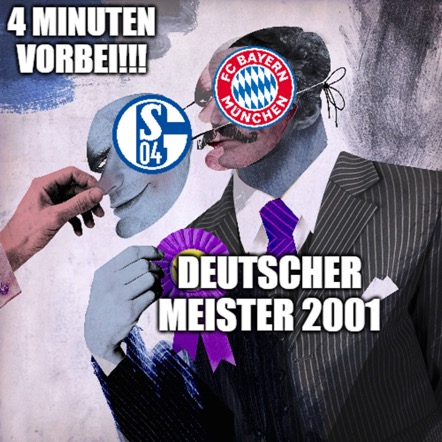
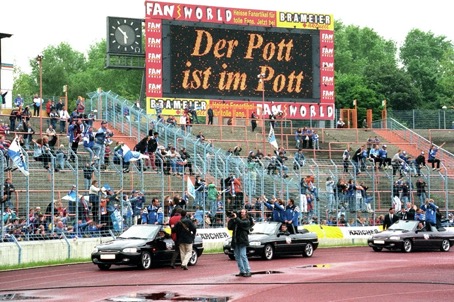
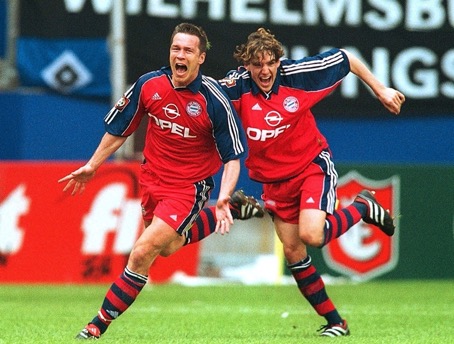
Four minutes in May: Few title deciders have moved the Bundesliga more than matchday 34 on May 19, 2001. After a wild 5-3 win (having trailed 0-2 and 2-3) against SpVgg Unterhaching, Schalke believed they were German champions. Title rivals Bayern München were trailing 0-1 at Hamburg. Sergej Barbarez had given HSV the lead. But in the fourth minute of injury time, Patrik Andersson equalised for Bayern — and Schalke's four-minute championship was over.
0-2 in the "Derby of the Century": Dortmund, May 12, 2007. A unique constellation in the history of the Ruhr rivalry. The Knappen had the chance to become German champions in the stadium of arch-rivals Borussia Dortmund. The BVB players, who had only secured survival a week earlier in Wolfsburg (2-0), had other ideas. Dortmund won 2-0 — and denied Schalke the title on their own turf.
Klopp ruins Schalke's title bid: In 2004/05, 1. FSV Mainz 05 were playing their first Bundesliga season. The professional underdogs from Rheinhessen caused a sensation, toppling league leaders Schalke from pole position on matchday 26. Jürgen Klopp's side won 2-1 against the heavily favoured Royal Blues — a result that proved decisive in the title race.
Destruction in Manchester: In the 2019 Champions League round of 16, Schalke 04 suffered the heaviest defeat in their European history. At Pep Guardiola's star-studded Manchester City, they were hammered 7-0 — a result that cost coach Domenico Tedesco his job. The first leg at the Arena had been lost only 2-3 after leading 2-1.
1-8 at Bayern — Toni in the goalstorm! European champion Harald "Toni" Schumacher at Schalke was one long embarrassment. After his exit from Köln and the national team, the goalkeeper planned a fresh start at the Knappen — and was overwhelmed. On April 9, 1988, Schalke 04 conceded the third-heaviest defeat in their Bundesliga history with Schumacher in goal.
The money: Even at their first relegation in 1980/81, Schalke were writing deep-red sporting figures. The decisive 0-6 against neighbours VfL Bochum (May 9, 1981) represented the heaviest home defeat in Bundesliga history and contributed significantly to the goals-against record (88) that season.
For the Lovers
Key triumphs and major victories
Schalke 04 won seven German championships through the 2019/20 season: 1957/58, 1941/42, 1939/40, 1938/39, 1936/37, 1934/35 and 1933/34. The Knappen also claimed five DFB-Pokal victories — in 2010/11, 2001/02, 2000/01, 1971/72 and 1937 — plus the 2011/12 Supercup.
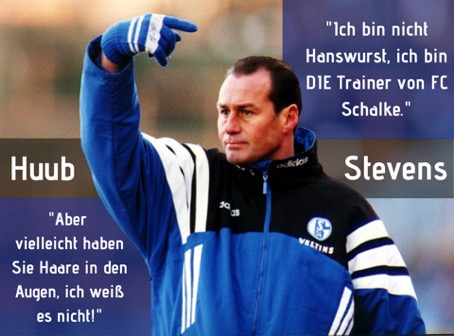
UEFA Cup winners 1997: The greatest success in the post-war era came under coach Huub Stevens in 1996/97. The Knappen won the UEFA Cup in a penalty drama against Inter Milan (4-2 on penalties after 0-1 in extra time; first leg: 1-0). En route to the final, they eliminated CD Tenerife, FC Valencia and FC Brugge.
DFB-Pokal and runners-up: The greatest domestic achievements in the first decade after the Bundesliga's introduction were the DFB-Pokal triumph — 5-0 against 1. FC Kaiserslautern in the Hanover final — and the 1971/72 runners-up finish. Only a 1-5 defeat at Bayern München in a direct first-versus-second showdown on the final matchday at the new Olympiastadion cost the title.
The legendary 4-0 at BVB: On September 23, 2000, the Bundesliga eagerly anticipated the return of World Cup winner Andreas Möller from Schalke 04 to Dortmund. The playmaker, who had marched from victory to victory with BVB, was mercilessly booed by the Black and Yellow faithful. In the end, Möller stood as the triumphant figure: Schalke won 4-0 (2-0) with goals from Jörg Böhme, Ebbe Sand, Emile Mpenza and Tomáš Rosický.
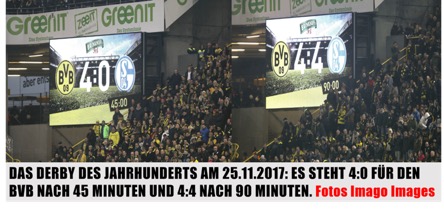
4-4 after 0-4: Schalke 04's most spectacular comeback in Bundesliga history came at arch-rivals Borussia Dortmund. On November 25, 2017, the Knappen trailed 0-4 until the 61st minute but refused to surrender. After an emotional half-time team talk from coach Domenico Tedesco, they tore themselves apart for their colours and equalised to a scarcely believable 4-4.
Jens Lehmann's computer trick: Milan, Giuseppe Meazza Stadium, May 21, 1997. FC Schalke 04 experienced the greatest moment in their modern history. Chilean striker Ivan Zamorano forced extra time for Inter Milan five minutes before the end of regulation after Schalke's 1-0 first-leg victory (goal: Marc Wilmots). What followed was one of football's most dramatic penalty shootouts — with Lehmann's legendary cheat sheet taped inside his water bottle.
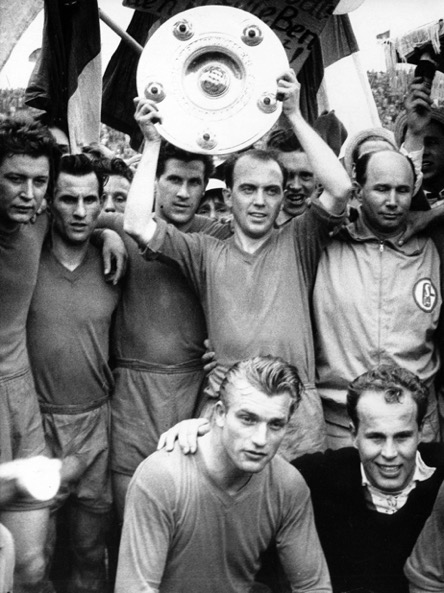
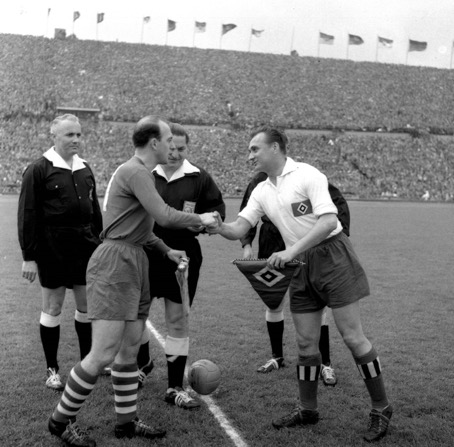
The last championship: Gelsenkirchen, May 19, 1958. The working-class city in the Ruhr awaited its champion heroes. Bernhard "Bernie" Klodt and co. had beaten Hamburger SV 3-0 in Hanover in the German championship final. Escorted by mounted police, the Schalke players presented the trophy to their euphoric fans from an open car — a scene from another footballing era.
7-0 at Bayern, 1976! The 1976/77 season — runners-up behind Borussia Mönchengladbach with 77 goals scored — was one of Schalke 04's finest Bundesliga campaigns. It was crowned by the club's biggest victory in the German top flight: a 7-0 win at Bayern München under coach Friedel Rausch on October 9, 1976.
The Miracle of Milan: The mockery from the travelling Schalke fans at Milan's Giuseppe Meazza Stadium was relentless. "Watch and learn, Bayern — that's how it's done," the Royal Blue faithful taunted the despised FC Bayern, who had been eliminated in the 2010/11 Champions League round of 16 despite winning 1-0 in Italy. In the preceding rounds, Schalke had already produced sensational results.
Most Important Persons
The men who shaped the club
A century game for his birthday: One day after his 18th birthday, the future World Cup winner played the match of his life. May 2, 1984. In a utterly wild 6-6 draw after extra time in the DFB-Pokal semi-final against Bayern München, the star of one of the greatest talents in S04 history was born…
"Mr. Bicycle Kick": FC Schalke 04's all-time record scorer (182 goals in 295 matches) is, with a total of 268 goals also scored for 1860 München, 1. FC Köln and VfL Bochum, the second-most prolific marksman in Bundesliga history behind Bayern bomber Gerd Müller (365 goals)…
The "century coach": Hired in 1996 as a no-name from Dutch Eredivisie side Roda Kerkrade to replace Jörg Berger, the granite-faced Hubertus Jozef Margaretha Stevens became a coaching idol at Schalke. In his first season with the Knappen, Stevens delivered the club's greatest triumph — the 1997 UEFA Cup…
The super-goalkeeper who moved to the "wrong" club: From the Nordkurve to the summit of football — Manuel Neuer, born 1988 in Gelsenkirchen-Buer, lived the dream of thousands of Schalke fans. He replaced veteran keeper Frank Rost at just 20 and rescued Schalke time and again — before his devastating transfer to Bayern München…
In 1950, the trained baker joined FC Schalke 04: From that point, he worked for the club almost without interruption. Initially, as a baker's apprentice, he delivered rolls to Ernst Kuzorra, the Schalke icon from the 1930s. Neumann was also a restaurateur and managed the club's catering — a life devoted entirely to S04…
(1990) — "Clemens, the Miner": No other player embodied the Schalke success years between 1933 and 1942 more. Ernst Kuzorra, himself still working underground at the Consolidation colliery until the mid-1920s, nourished the myth of the footballing miner and, together with his partner Szepan, forged the "Schalker Kreisel" that dominated German football…
Personae Non Gratae
The men fans love to hate
God forgives, Schalke never! Many Schalke fans blame the referee from 1. FC Kaiserslautern for the fact that "their" S04 ended the 2001 championship race as mere "Champions of Hearts." In their view, Merk made crucial errors in the pivotal parallel match between Hamburg and Bayern that cost Schalke the title…
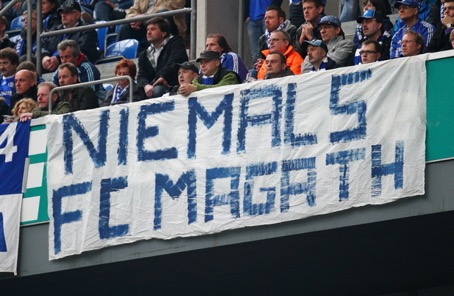
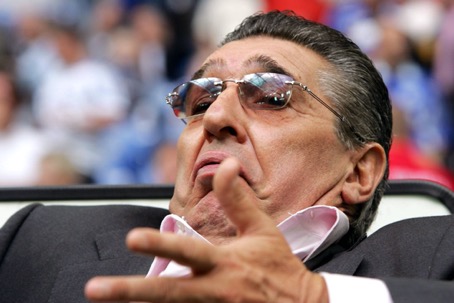
The unapproachable God-Emperor: Former international Magath coached many Bundesliga clubs — his beloved Hamburger SV, Bayern, Werder Bremen. He saved Eintracht Frankfurt and VfB Stuttgart from relegation in 2000 and 2001 respectively, and made VfL Wolfsburg champions. At Schalke, his autocratic reign ended in spectacular failure…
Assauer's favourite enemy: Leverkusen's star striker was the most prolific scorer of the 1990s — and a personalised Schalke nightmare. In 18 Bundesliga matches against the Blues, "Der Schwatte" scored ten times. And once he lashed out physically: on December 6, 1997, during the 0-0 in Leverkusen…
The lout from BVB: "Just finish them off," the former Dortmund player wrote in a post in April 2019. "You can do without Schalke for a year." He continued on Instagram: "Lads, shut them up on Saturday."… The provocations of a man who embodied the Dortmund side of the rivalry…
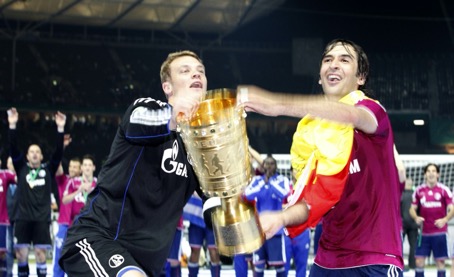
Tragic
Those who suffered misfortune
Rudi Assauer — Macho with a heart: Rudolf "Rudi" Assauer made 307 Bundesliga appearances between 1964 and 1976 for Borussia Dortmund (not Schalke 04) and Werder Bremen. After unsuccessful attempts as a coach, he became manager at Werder Bremen and later at Schalke, where he transformed the club — building the Arena AufSchalke and engineering the 1997 UEFA Cup triumph. His later diagnosis of Alzheimer's disease became a deeply moving public story.
Bernd Tönnies — The big brother: Bernd Tönnies was elected new president of FC Schalke 04 at an extraordinary members' meeting on February 7, 1994. He was 41 years old, highly successful in business, but already health-compromised after a heart attack. His presidency would be defined by ambition, controversy and the shadow of his more famous brother Clemens.
Stan Libuda — Stan the Man: Reinhard "Stan" Libuda is a legend in the Ruhr — a kind of German Garrincha. And that at both Schalke 04 and Borussia Dortmund. The right winger's career began in Gelsenkirchen's youth ranks before he joined the first-team squad in 1961 and became a Schalke icon.
Libuda is one of the very few players to have moved between rival clubs Schalke 04 and Borussia Dortmund and still be revered by both sets of fans.
The nickname "Stan" was inspired by the legendary English winger Stanley Matthews. Libuda's dribbling ability remains the stuff of legend. When in the 1960s the preacher Werner Heukelbach toured the Ruhr with posters reading "Nobody gets past Jesus," someone scrawled underneath: "except Stan Libuda."
Over the years, the phrase evolved into "Nobody gets past God — except Stan Libuda," an early precursor to Chuck Norris facts. The saying also became the subtitle of a musical about FC Schalke 04.
In 1970, during the World Cup in Mexico, Bulgaria's coach said after his defenders had been bamboozled by the dribbling Libuda: "You can only stop this man with a rifle."
In 2003, a fan discovered a spelling error on Reinhard Libuda's gravestone — "Reinhard" was misspelled with "ai" instead of "ei." The fan contacted FC Schalke 04; manager Rudi Assauer promised to commission a new gravestone. But it wasn't until 2004, after protests by another Libuda fan, that the correction was finally made.
The access road west of the Veltins-Arena in Gelsenkirchen is named "Stan-Libuda-Weg."
OMG — Oh My God
You can't be serious
Co-opted, exploited, instrumentalised, bought — FC Schalke 04 in the currents of history. The working-class club's popularity was from the start both a great asset and a vulnerable one. The naïve Schalke found themselves caught in the machinery of politics, propaganda and officials' madness — both during the Nazi era and again in 2001.
Schalke 04 and the Nazis — a dangerous game: The most successful years of FC Schalke 04 coincided with the Third Reich. Between 1934 and 1942, the team reached at least the championship or cup final every year, building an enormous and enduring popularity across Germany. The team's success around Ernst Kuzorra and Fritz Szepan became entwined with the regime's propaganda machine.
Schalke and the Bundesliga scandal — a dirty game: In 1971, FC Schalke 04 were involved in the Bundesliga match-fixing scandal. For bribes, the team had deliberately lost 0-1 to Arminia Bielefeld on April 3, 1971. Numerous S04 professionals, including internationals Klaus Fichtel, Klaus Fischer, Reinhard Libuda and Rolf Rüßmann, were put on trial — a stain on the club's history.
Champions League on 9/11 — an unworthy game: September 11, 2001 — the day that changed the world. Terror attacks on the USA claimed more than 3,000 lives. Football was the last thing on anyone's mind. But UEFA pressed ahead with the scheduled Champions League matchday under the motto "the show must go on." Schalke 04 had to play at home against Panathinaikos Athens — a match that felt grotesque in its timing.
Schalke on the silver screen? A farcical game! Germany and its football films — not always Oscar-worthy entertainment. That also goes for "Fußball ist unser Leben" by Tomy Wigand from 2000. The film depicts the life and suffering of "Hans Pollack" (alias Uwe Ochsenknecht) and his fellow fans with and for FC Schalke 04. Rudi Assauer, Huub Stevens and cult figures all made cameo appearances.
Ernst Kuzorra's second burial — a farce. Only at Schalke! On New Year's Day 1990, "Königsblau" mourned one of their greatest players. Ernst Kuzorra had died at the age of 84. The man who left behind such unique wisdom as: "I was running forward with the ball and didn't know what to do with it. So I just smacked it into the goal." Years later, the club would have to exhume and rebury him — a bizarre coda to a legendary life.
Fun Facts
Knowledge for blowhards, braggadocios and connoisseurs
FC Schalke 04 as "Champions of Hearts" — that's a guaranteed conversation-starter at any football pub. But here are fun facts of a special kind — knowledge for blowhards, braggadocios and connoisseurs.
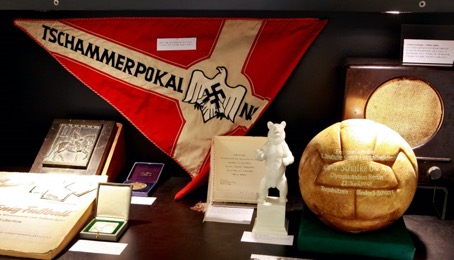
The first "Double" winners: FC Schalke 04 became the first German club to win the "Double" of championship and cup in 1937 — the cup then known as the Tschammer-Pokal. The cup final against Fortuna Düsseldorf was actually played in January 1938 due to scheduling issues.
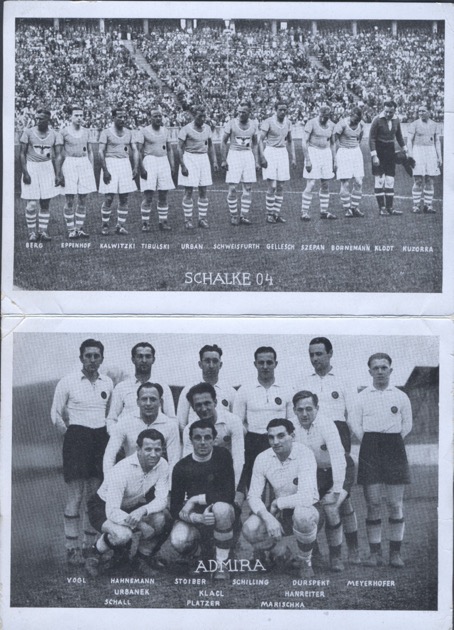
Twice against the Viennese: FC Schalke 04 achieved a unique feat. During the Third Reich, in the Second World War, the Gelsenkirchen club were the only team to win the championship twice against a Viennese side — in 1939 with an incredible 9-0 against Admira and in 1942 with a 2-0 against First Vienna.
"FC Meineid" (FC Perjury): Opposition fans, particularly in Dortmund, still mock the seven-time champions with this nickname due to the club's involvement in the Bundesliga match-fixing scandal.
Thon hands back the armband: Olaf Thon made 295 appearances for FC Schalke 04 in the 1. and 2. Bundesliga. In 2008, he was inducted into the Gelsenkirchen club's "Hall of Fame." Just as well — because only a year later, in 2009, honorary captain Thon, who felt his "experience and expertise" were insufficiently valued at Schalke, and the Ruhr club fell out. Temporarily…
The Knappen are almost always skint: No club in Germany has ever been as indebted as FC Schalke 04 (as of December 2019). For the construction of the Arena AufSchalke, the club took on around €285 million from 1998 onwards. According to the June 30, 2012 annual report, liabilities still stood at €173.1 million on the eve of the Bundesliga's 50th anniversary in summer 2013.
18 instead of 16: Schalke are substantially responsible for the Bundesliga playing with 18 clubs today. Initially there were only 16, and in 1965 Schalke and Karlsruher SC had been relegated on sporting merit. Then financial irregularities at Hertha BSC became public, leading to the Berliners' forced relegation. By the time the DFB decided who would get the vacant spot, the league had expanded — and Schalke stayed up.
One cult club, three stadiums: FC Schalke 04 are, alongside FC Bayern München, the only club to have played their Bundesliga home matches at three different stadiums (as of December 2019). The Glückauf-Kampfbahn was followed in 1973 by the Parkstadion, which was replaced in 2001 by the Arena AufSchalke.
Most goals in a season: Klaus Fischer in 1975/76 and Klaas-Jan Huntelaar in 2011/12 each managed 29 goals. In both cases, this naturally earned the "Torjägerkanone" as the Bundesliga's top scorer.
Special Moments
Special: Fun Facts zum Derby Schalke 04 gegen Borussia Dortmund
Elf Fun Facts zur Mutter aller Derbies in Deutschland: Schalke vs. Dortmund, chronologisch geordnet:
(1) Das Derby am 3. Mai 1925: Schalke 04 schlägt Borussia Dortmund 4:2
The derby on May 3, 1925 is widely regarded as the birth of the Schalker Kreisel. In the Ruhrgau championship of regional leagues, S04 beat BVB 4-2. "Short and flat, the ball wandered from man to man," wrote the Dortmunder Generalanzeiger about Schalke's play. Ernst Kuzorra, 19 years old, scored two goals.
(2) S04's highest derby victory, October 20, 1940: Schalke 04 10 — Borussia Dortmund 0
In the Gauliga Westfalen, S04 "shredded" BVB 10-0. Ernst Kuzorra scored four goals in the first half. Only 3,000 spectators witnessed the Schalke victory at the Glückauf-Kampfbahn.
(3) The first Bundesliga derby, September 7, 1963: Schalke 04 3 — Borussia Dortmund 1
Reinhold Wosab scored the first Bundesliga goal in a Schalke-Dortmund derby in the sixth minute — for BVB. But Schalke were stronger on the day and scored three times within 14 minutes.
(4) The derby without visibility, November 12, 1966: Borussia Dortmund 6 — Schalke 04 2
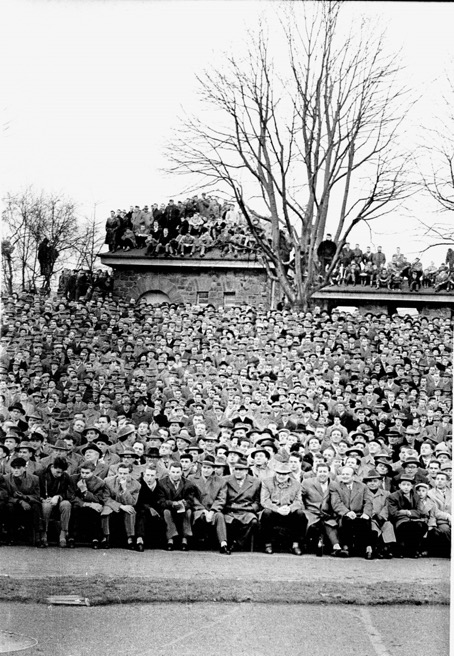
"Whenever the ball was kicked into the fog, I ran after it. That was exhausting, but fine," reported referee Gerd Henning after the match. Why he started the game at all, he didn't say. At the Stadion Rote Erde, 38,000 spectators saw practically nothing. The players didn't see much more. "We had to shout the score to each other across the pitch," one participant recalled.
(5) Der Hundebiss vom 06.09.1969: Borussia Dortmund - Schalke 04 1:1
Friedel Rausch lies on the pitch, backside exposed — it hurts. Alsatian "Rex" has bitten him. The reason: hundreds of Schalke fans had stormed the pitch celebrating Hansi Pirkner's 1-0 goal. The Dortmund stadium dog found this threatening and bit. Rausch got a tetanus shot and played on. His teammate Gerd Neuser had to leave the field after a dog bite to the calf.
(6) Klaus Fichtels Abschied vom 22.04.1986: Borussia Dortmund - Schalke 04 1:1
Wise Words
Quotes for eternity
Special Moments — A phone call to become Schalke coach: How Huub Stevens came to "Königsblau"
It was a peculiar day at Schalke. On October 5, 1996, it was actually an ordinary Bundesliga match against Karlsruher SC (0-1). But: total silence reigned. No chanting, no trumpeter in the Nordkurve of the Gelsenkirchen Parkstadion.Beneath the huge scoreboard in the Schalke fan end, the reason for the boycott could be read on ten cardboard signs: J-Ö-R-G B-E-R-G-E-R. The popular coach had been sacked by the "Königsblau" board after a 2-3 DFB-Pokal defeat to Ruhr rivals VfL Bochum. On the coaching bench — or rather the ejector seat — sat interim coach Juri Jara…
What nobody suspected: at Kerkrade, the team from southern Limburg, Berger's successor was sitting on the bench. Four days after the mourning match against KSC, a man would appear at Schalke who, with his angular but straightforward manner, would change much for the better at the tradition-rich club. His name was known only to connoisseurs of Dutch football until then…
Assauer knew exactly what he was doing. He acted strategically, not instinctively. Huub Stevens had caught his eye much earlier than is generally assumed. In summer 1995, Schalke played a pre-season tournament at Roda Kerkrade, coached by Stevens since 1993. Alongside Roda and Schalke, Eintracht Frankfurt also participated — and Assauer watched Stevens work closely.
After Schalke parted ways with Berger, Stevens' long-time assistant Eddy Achterberg appeared to display clairvoyant abilities. "Then you'll be the new Schalke coach," he prophesied to his boss over dinner. Stevens looked up with his dark, piercing eyes: "Don't joke, Eddy."
Two days later, the phone rang…Stevens called back. But he made it clear to Assauer that he had a contract at Roda Kerkrade which he might want to extend. "That's irrelevant," Assauer countered in his typically monosyllabic way. He wanted to keep the move under wraps. There wasn't much time. The BILD reporters lurking at the training ground daily wouldn't be kept in the dark much longer.
There was no shortage of alpha males at FC Schalke 04 in those days. Goalkeeper Jens Lehmann, the powerful captain Olaf Thon, Mike Büskens and Youri Mulder — Stevens had to weld them all back into a genuine unit. He did so with discipline, but also with personal warmth. Stevens knew every detail, even all the children's birthdays within the squad.
"We beat Roda, we beat Trabzon, we beat Brugge anyway, Valencia, Tenerife, Inter Milan — that was a show!" the Schalke fans would sing in rapture at the end. Via those stations, FC Schalke 04 reached the 1997 UEFA Cup finals with Huub Stevens. "This team will appear in the history books," Olaf Thon proclaimed…